

Apple Music and Tidal are priced almost identically, yet they're built for different kinds of listeners. Apple Music is designed around ecosystem integration and broad accessibility. Tidal is designed around audio quality and artist economics. The right choice depends heavily on what hardware you're using, how deeply you're embedded in Apple's ecosystem, and whether audio fidelity or convenience matters more to you.
This comparison covers library, audio quality, pricing, interface, and the scenarios where each service genuinely wins—with enough technical detail to be useful if you care about that, and clear plain-English conclusions if you don't.
Apple Music vs. Tidal: Quick Overview
Who Apple Music Is Best For
Apple Music is ideal for listeners who are deeply embedded in the Apple ecosystem, enjoy intuitive app design, and want cutting-edge features like Spatial Audio and seamless integration with iPhone, iPad, Mac, Apple Watch, and HomePod.
Who Tidal Is Best For
Tidal is best suited for audiophiles and music purists who prioritize best-in-class sound quality, transparent artist compensation, and exclusive content. Also, with its emphasis on HiFi and HiFi Plus tiers, it can be a great choice for users who listen with high-end headphones or home audio systems.
Apple Music vs. Tidal Music Library and Content Availability
Library and Content
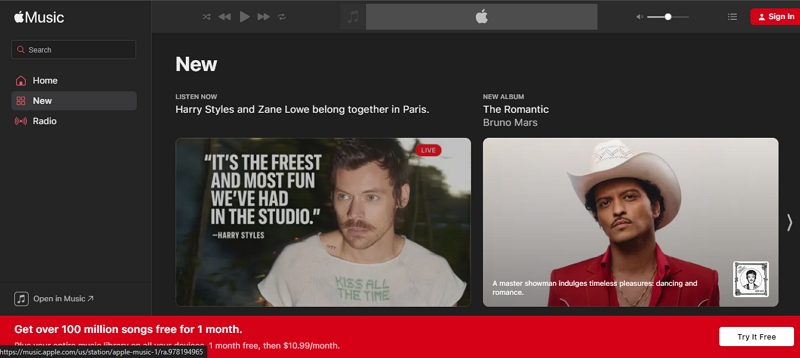
Apple Music's catalog exceeds 100 million tracks with strong genre breadth—pop, hip-hop, R&B, classical, world music, and niche genres all have solid coverage. Beyond the catalog, Apple Music produces original radio content through Apple Music Radio (Beats 1 / Apple Music 1), with shows hosted by artists and DJs that function more like curated editorial programming than algorithmic playlists. Music videos, live sessions, and behind-the-scenes content are integrated directly into the app rather than treated as separate media.
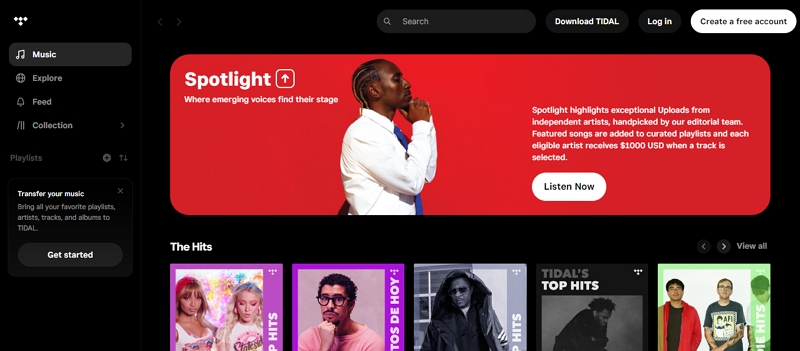
Tidal's catalog sits around 90 million tracks. Where Tidal differentiates itself is in artist-first exclusives and editorial depth. Tidal has historically secured exclusive album releases and early access content from major artists, though the volume of these exclusives has decreased somewhat since its earlier years. Its editorial playlist curation leans toward music discovery and genre storytelling rather than mood-based recommendations—if you follow specific genres closely or care about finding deep cuts, Tidal's editorial approach is genuinely different from what Apple Music offers.
Verdict: For most listeners, catalog size is a non-issue—both services have essentially everything. The meaningful difference is in content type: Apple Music for radio and video integration, Tidal for editorial depth and exclusive access.
Audio Quality
Apple Music
Apple Music streams at 256kbps AAC by default. For listeners who want better, it offers Lossless (up to 24-bit/48kHz) and Hi-Res Lossless (up to 24-bit/192kHz) using ALAC—and these tiers are included in the base subscription at no extra cost.
The practical catch: Hi-Res Lossless requires a wired connection and an external DAC to actually deliver the full quality benefit. Bluetooth audio, including AirPods, cannot carry true lossless audio—the signal is transcoded before it reaches the headphone, regardless of what quality tier you've enabled. For most wireless listeners, the audible difference between 256kbps AAC and lossless is minimal on typical consumer hardware.
Where Apple Music has a clear, hardware-independent advantage is Spatial Audio with Dolby Atmos. This works over Bluetooth and AirPods and creates a genuine sense of three-dimensional space in mixes that have been produced for it. The effect is most pronounced in pop, hip-hop, and film score productions where producers have specifically mixed for Atmos. On AirPods Pro or AirPods Max, well-produced Atmos tracks are noticeably different from standard stereo—it's not a subtle effect.
Tidal
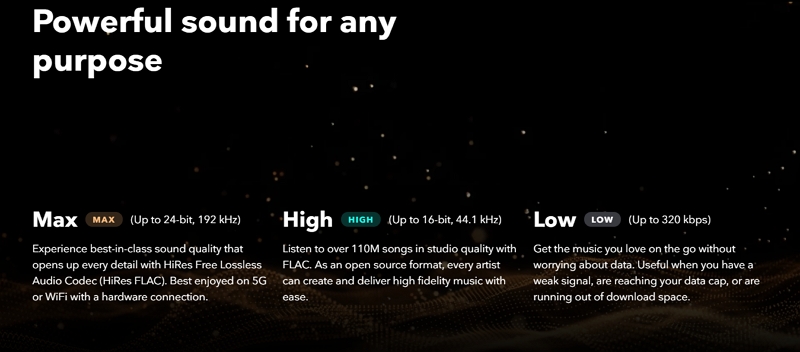
Tidal restructured its audio tiers in 2023. The current structure is:
- Low: up to 320kbps AAC — solid everyday quality
- High: Lossless FLAC at 16-bit/44.1kHz (CD quality) — included in the standard HiFi plan
- Max: HiRes FLAC at up to 24-bit/192kHz — requires HiFi Plus plan
Tidal also supports Sony 360 Reality Audio on the HiFi Plus tier, which is Sony's spatial audio format competing with Dolby Atmos. Support is limited to specific Sony hardware and some supported headphones—it's not as broadly accessible as Apple Music's Atmos implementation.
The notable difference in Tidal's approach: FLAC is an open format with broad hardware support across dedicated audio players, desktop DACs, and high-end home audio systems. Audiophiles with existing non-Apple equipment often find FLAC more practical than ALAC, which requires Apple software or ALAC-compatible players to decode.
Real-World Comparison
On standard consumer headphones or earbuds—the kind most people use daily—the audible difference between Apple Music and Tidal is negligible. Both services deliver clean, detailed audio at their respective lossless tiers, and the source quality (how the album was mastered) matters far more than which codec carries it.
The gap opens with higher-end equipment. On a dedicated DAC with quality wired headphones, Tidal's HiRes FLAC tracks have an advantage in device compatibility—more high-end audio hardware is designed around FLAC than ALAC. For listeners with this kind of setup, Tidal HiFi Plus is the more natural fit.
Apple Music's Spatial Audio advantage is real and accessible without any special hardware investment. If you're listening on AirPods and streaming pop or hip-hop, Atmos support is genuinely valuable and something Tidal doesn't match.
For wireless listeners on consumer hardware, Apple Music wins on value—lossless included at base price, plus Spatial Audio that works immediately. For dedicated audiophile setups with external DACs and high-end headphones, Tidal HiFi Plus offers broader hardware compatibility and comparable resolution. Neither service has a clear technical edge on sound quality when everything else is equal—the difference is ecosystem fit and how you're listening.
Apple Music vs. Tidal Pricing and Subscription Plans
Apple Music
Apple One is worth calculating against your current Apple subscriptions—if you already pay for TV+ and iCloud, the bundle is often cheaper than paying separately.
Tidal
Tidal's free tier availability varies significantly by region—in some markets it's unavailable entirely.
At the $10.99 base tier, Apple Music includes high-res lossless audio while Tidal includes only CD-quality lossless. To match Apple Music's resolution on Tidal, you need the $19.99 HiFi Plus plan. For most listeners, Apple Music delivers better base-tier value. Tidal's free tier is an advantage for testing the service before committing.
Interface and Usability
Apple Music
Apple Music's interface centers on four tabs: Listen Now (personalized recommendations), Browse (editorial and new releases), Radio, and Library. Navigation is fast and the layout is familiar to anyone who has used an iOS app. Recommendations improve meaningfully with use—after a few weeks of regular listening, the algorithmic suggestions in Listen Now become genuinely useful rather than generic.
The integration with Apple hardware is the strongest part of the experience: Siri voice control works natively, handoff between devices is seamless (start on iPhone, continue on Mac without any re-queuing), and HomePod integration is effortless. If you're embedded in Apple hardware, the experience feels like a natural extension of the device rather than a third-party app.
Tidal
Tidal's interface is organized around Home, Search, My Collection, and Feed. The editorial content is more prominent than on Apple Music—genre guides, artist interviews, and curated "moments" playlists are surfaced throughout browsing rather than being tucked into a separate section. For listeners who enjoy music discovery as an active process, this approach is engaging.
Cross-platform consistency is Tidal's interface strength—the experience on Android, desktop, and web is nearly identical, without the platform-specific advantages (or limitations) that Apple Music has. Tidal works equally well on a Windows desktop and an Android phone, which Apple Music does not.
Apple Music wins on Apple hardware due to native integration. Tidal wins on cross-platform consistency and editorial discovery. If you're not primarily on Apple devices, Tidal's interface experience is comparable or better.
Verdict: Pricing and Value for Money Comparison
Tidal and Apple Music are priced very similarly, so choosing between them isn’t simply a matter of cost. But they have unique strengths that makes them stand out.
If seamless integration across devices — especially within the Apple ecosystem — is a priority, Apple Music delivers strong overall value. You get lossless and high-resolution audio included in the base subscription, making it a convenient, all-in-one option. On the other hand, if you prioritize audio fidelity above everything else, Tidal is a compelling alternative. For roughly the same price, you can enjoy high-resolution FLAC streaming designed for audiophile-focused audiences.
Who Should Choose What
Choose Apple Music if:
- You use iPhone, Mac, iPad, Apple Watch, or HomePod and want seamless device integration
- You listen on AirPods or Beats headphones and want Spatial Audio to work immediately
- You want lossless audio included at the base subscription price
- You're interested in Apple Music Radio programming
- You already subscribe to other Apple services and want bundle value through Apple One
Choose Tidal if:
- You listen with dedicated audio equipment—a DAC, amplifier, or high-end wired headphones—and want broad format compatibility with FLAC
- Supporting artists through a higher-royalty model matters to you
- You use non-Apple devices primarily (Android, Windows) and want a consistent cross-platform experience
- You want a free tier to test before committing
- You're interested in Sony 360 Reality Audio and have compatible hardware
Neither is clearly better for:
- Casual listeners on standard earbuds—the quality difference at base tiers is not audible in typical conditions
- Pure catalog breadth—both services have essentially everything
Switching Between Platforms or Managing Your Local Library
If you're deciding between the two services and want to trial both, or if you're switching from one to the other, a few tools make the transition straightforward.
Playlist migration: Soundiiz (soundiiz.com) is the most reliable option for transferring playlists, liked songs, and followed albums between Apple Music and Tidal. It connects to both accounts via OAuth—no passwords stored—and migrates in a few minutes. A free tier handles basic transfers; the paid plan (~$4.50/month) covers bulk migration and automated sync if you want to keep both accounts in parallel during a trial period.
Local file management for Plex or offline use: Mediaio Audio Converter handles format conversion for music files you already own—iTunes purchases, CD rips, or files downloaded from Bandcamp or HDtracks. It converts between MP3, FLAC, WAV, AAC, and AIFF in batch, which is useful if you want to standardize your local library before adding it to Plex, a NAS, or a dedicated audio player. It works on files you own locally and doesn't interact with streaming service DRM.
Audiophile library management: Roon (~$14.99/month or $829.99 lifetime) is worth mentioning for serious listeners building a local library alongside a streaming subscription. Roon integrates with Tidal and Qobuz natively, manages local FLAC files, and provides a genuinely excellent interface for high-end listening setups. It's overkill for casual use but is the standard tool in audiophile circles for a reason.
FAQ
For most everyday listening setups, the audible difference is minimal. On dedicated audiophile hardware with a DAC and high-end wired headphones, Tidal HiFi Plus has broader FLAC compatibility. For spatial audio on consumer headphones like AirPods, Apple Music's Dolby Atmos implementation is more accessible and extensive.
Yes. Apple Music includes Lossless (up to 24-bit/48kHz) and Hi-Res Lossless (up to 24-bit/192kHz) in ALAC format at no extra subscription cost. Hi-Res playback requires a wired connection and compatible hardware.
At the base individual tier, both are $10.99/month. Apple Music includes high-res lossless at that price. Tidal's high-res tier (HiFi Plus) costs $19.99/month. For lossless CD-quality audio, Tidal HiFi and Apple Music are the same price.
Yes. Third-party services like Soundiiz, TuneMyMusic, and FreeYourMusic can migrate playlists, liked songs, and favorites between both platforms. The process takes about 10 minutes for a typical library.
Tidal offers a free ad-supported tier in select regions. Availability varies by market—it's not available everywhere. A trial period is available in most regions where the free tier isn't offered.
It works on Android and Windows, but the integration advantages that make Apple Music compelling are significantly reduced outside the Apple ecosystem. On non-Apple devices, Tidal and Apple Music are more comparable, and Tidal's FLAC format has slightly better hardware support outside Apple.